

Children with Autism Process Auditory Information Differently

A team of scientists, including researchers from the HSE Centre for Language and Brain, examined specific aspects of auditory perception in children with autism. The scientists observed atypical alpha rhythm activity both during sound perception and at rest. This suggests that these children experience abnormalities in the early stages of sound processing in the brain's auditory cortex. Over time, these abnormalities can result in language difficulties. The study findings have been published in Brain Structure and Function.
Autism spectrum disorders (ASD) are a group of conditions caused by abnormalities in brain development that can affect communication skills and social behaviour. Children with ASD often experience co-occurring language impairments, ranging from mild language deficits to a complete inability to speak.
The causes of language impairment in ASD are not yet well understood. Researchers believe that the neurobiological mechanisms of autism stem from an imbalance between excitatory and inhibitory processes in the cerebral cortex, driven by oscillations of nerve cells in the brain. These oscillations produce weak but detectable electromagnetic signals, such as alpha, beta, and gamma rhythms, which can be measured using magnetoencephalography (MEG).
An international team of researchers, including scientists from the HSE Centre for Language and Brain, studied alpha rhythm oscillations (markers of excitability) in children with autism. Alpha rhythms play a key role in processing sensory information and maintaining attention, eg during auditory perception.
The scientists explored the relationship between sound perception and language impairment in children with ASD. To achieve this, they used magnetoencephalography to measure brain activity in 20 children with autism of varying severity and in 20 typically developing controls. All study participants underwent clinical and behavioural language assessments, as well as tests for nonverbal intelligence (IQ) and the severity of autistic traits. Their language skills were measured using RuCLAB (Russian Child Language Assessment Battery). During the MEG, participants were presented with sound stimuli while their brain activity was measured, requiring no special actions from them. The authors of the experiment monitored alpha oscillations both at rest and during the processing of presented audio signals.
It was found that children with autism exhibit impaired alpha rhythms both during auditory perception and at rest. Typically, when sounds are processed in the auditory cortex, the power of alpha waves decreases significantly, while it increases during rest. The opposite pattern was observed in children with autism.
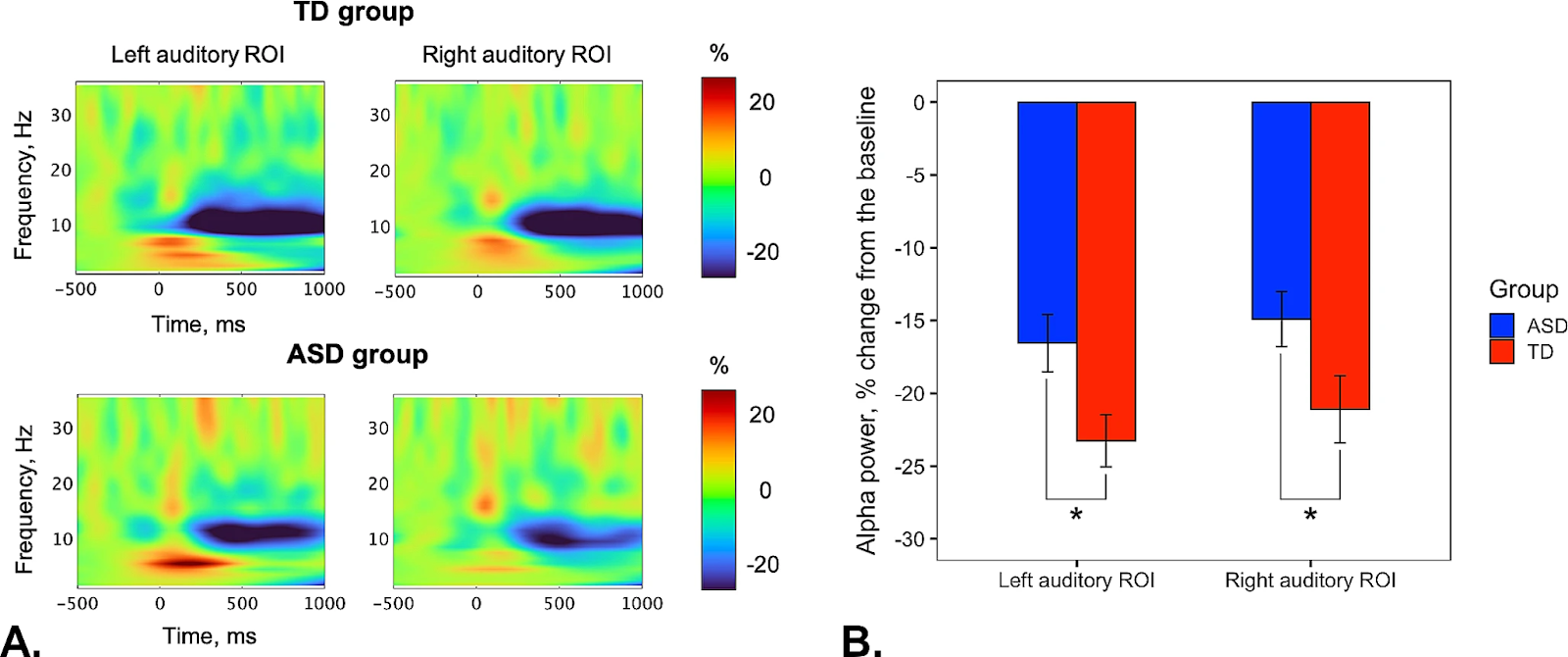
'A slight decrease in alpha rhythm power during auditory information processing in children with autism indicates increased excitability of neural networks in the auditory cortex, confirming an imbalance between excitation and inhibition in the cerebral cortex,' explains Vardan Arutiunian, co-author of the study and research fellow at the Seattle Children's Research Institute, USA.
The authors of the paper also found a link between brain activity at rest in the left auditory cortex and the language abilities of children with ASD. The researchers converted the complex, multidimensional MEG signals into a set of parameters, analysed them, and discovered that one component of the signal (offset), which reflects the average frequency of neural discharges, is associated with language skills. The higher this parameter (and consequently, the greater the resting neural excitability in the left auditory cortex), the poorer the language skills of children with ASD.

Olga Dragoy
'We analysed all the data collected during the experiment, including the MEG results, IQ tests, and assessments of autistic traits and language skills. It was found that children with more impaired neural processes in the left hemisphere exhibited poorer language abilities. We observed that in autism, abnormalities are present at the early stages of information processing in the auditory cortex, which can impact higher-level processes such as language,' according to Olga Dragoy, Director of the HSE Centre for Language and Brain.
The study's findings can lead to a better understanding of the causes of language impairment in autism spectrum disorders and contribute to the development of corrective interventions.
See also:

Banking Crises Drive Biodiversity Loss
Economists from HSE University, MGIMO University, and Bocconi University have found that financial crises have a significant negative impact on biodiversity and the environment. This relationship appears to be bi-directional: as global biodiversity declines, the likelihood of new crises increases. The study examines the status of populations encompassing thousands of species worldwide over the past 50 years. The article has been published in Economics Letters, an international journal.
Scientists Discover That the Brain Responds to Others’ Actions as if They Were Its Own
When we watch someone move their finger, our brain doesn’t remain passive. Research conducted by scientists from HSE University and Lausanne University Hospital shows that observing movement activates the motor cortex as if we were performing the action ourselves—while simultaneously ‘silencing’ unnecessary muscles. The findings were published in Scientific Reports.
Russian Scientists Investigate Age-Related Differences in Brain Damage Volume Following Childhood Stroke
A team of Russian scientists and clinicians, including Sofya Kulikova from HSE University in Perm, compared the extent and characteristics of brain damage in children who experienced a stroke either within the first four weeks of life or before the age of two. The researchers found that the younger the child, the more extensive the brain damage—particularly in the frontal and parietal lobes, which are responsible for movement, language, and thinking. The study, published in Neuroscience and Behavioral Physiology, provides insights into how age can influence the nature and extent of brain lesions and lays the groundwork for developing personalised rehabilitation programmes for children who experience a stroke early in life.
Scientists Test Asymmetry Between Matter and Antimatter
An international team, including scientists from HSE University, has collected and analysed data from dozens of experiments on charm mixing—the process in which an unstable charm meson oscillates between its particle and antiparticle states. These oscillations were observed only four times per thousand decays, fully consistent with the predictions of the Standard Model. This indicates that no signs of new physics have yet been detected in these processes, and if unknown particles do exist, they are likely too heavy to be observed with current equipment. The paper has been published in Physical Review D.
HSE Scientists Reveal What Drives Public Trust in Science
Researchers at HSE ISSEK have analysed the level of trust in scientific knowledge in Russian society and the factors shaping attitudes and perceptions. It was found that trust in science depends more on everyday experience, social expectations, and the perceived promises of science than on objective knowledge. The article has been published in Universe of Russia.
Scientists Uncover Why Consumers Are Reluctant to Pay for Sugar-Free Products
Researchers at the HSE Institute for Cognitive Neuroscience have investigated how 'sugar-free' labelling affects consumers’ willingness to pay for such products. It was found that the label has little impact on the products’ appeal due to a trade-off between sweetness and healthiness: on the one hand, the label can deter consumers by implying an inferior taste, while on the other, it signals potential health benefits. The study findings have been published in Frontiers in Nutrition.
HSE Psycholinguists Launch Digital Tool to Spot Dyslexia in Children
Specialists from HSE University's Centre for Language and Brain have introduced LexiMetr, a new digital tool for diagnosing dyslexia in primary school students. This is the first standardised application in Russia that enables fast and reliable assessment of children’s reading skills to identify dyslexia or the risk of developing it. The application is available on the RuStore platform and runs on Android tablets.
Physicists Propose New Mechanism to Enhance Superconductivity with 'Quantum Glue'
A team of researchers, including scientists from HSE MIEM, has demonstrated that defects in a material can enhance, rather than hinder, superconductivity. This occurs through interaction between defective and cleaner regions, which creates a 'quantum glue'—a uniform component that binds distinct superconducting regions into a single network. Calculations confirm that this mechanism could aid in developing superconductors that operate at higher temperatures. The study has been published in Communications Physics.
Neural Network Trained to Predict Crises in Russian Stock Market
Economists from HSE University have developed a neural network model that can predict the onset of a short-term stock market crisis with over 83% accuracy, one day in advance. The model performs well even on complex, imbalanced data and incorporates not only economic indicators but also investor sentiment. The paper by Tamara Teplova, Maksim Fayzulin, and Aleksei Kurkin from the Centre for Financial Research and Data Analytics at the HSE Faculty of Economic Sciences has been published in Socio-Economic Planning Sciences.
Larger Groups of Students Use AI More Effectively in Learning
Researchers at the Institute of Education and the Faculty of Economic Sciences at HSE University have studied what factors determine the success of student group projects when they are completed with the help of artificial intelligence (AI). Their findings suggest that, in addition to the knowledge level of the team members, the size of the group also plays a significant role—the larger it is, the more efficient the process becomes. The study was published in Innovations in Education and Teaching International.